12/11/11
Pumping 411 - Getting the Most Milk
Well, I just learned some new things in training that may be helpful to you.
Here's what I knew...I knew that you can pump just a few times a day after nursing your baby to increase demand and after a few days, you'll get a little more, a little more, and a little more. Usually. Obviously this is different for all women, and it can vary depending on how old your baby is and how effective a pumper you are. I also knew that mother's milk teas can help support this process. The few times I've tried this I've had a couple cups of the tea during the day whenever I thought of it, and pumped using a double pump maybe twice a day after nursing Chase. I found this very effective.
What I didn't know was that combining hand expression and hands on pumping can, on average, DOUBLE the yield from a single session. Now...this is more important that just having more milk...and empty breast makes milk faster than a full breast, so the emptier the breast, the faster it fills...the more milk it thinks it needs to make! So how do you do it?
Here is a great handout sheet from LLL about hand expression. This is a good guideline to start with, but pay attention to what works for you and modify how it works best. The research showed that if a mother starts her letdown with hand expression then begins using the pump, she will have more success, especially if she generally has a problem letting down to the pump. If you have 7.5 minutes and are interested in a video about it, this is very informative: http://newborns.stanford.edu/Breastfeeding/HandExpression.html
Pump until the milk slows to a drip or stops flowing, remove your pump flanges, massage and stroke the breasts, begin using the pump again in single mode, and do some massage and compressions WHILE pumping at your most efficient settings with your pump. Then massage and stroke the other breast, begin pumping and doing the massage and compressions to drain the breast a little more.
Now...hand express until you can't get anymore! Combine the milk, chill...done! Now...this sounds like a lot of work, and it can be, but you can pick and choose what works well enough for you. The mother's in the study who used this method took about 25 minutes total to express both breasts. Many moms don't have this kind of time to commit, so what should you do?
Get your breasts warmed up before putting your pump on a fast cycle and starting to pump. Once your milk begins to spray, slow the cycles down and turn the pump to your most efficient suction setting (where it is comfortable but removing milk). Your milk flow will slow, turn your pump back to the faster cycle and shake the girls around! Try turning it back to the slower cycle speed again to see if you get more, do compressions until you just can't get anymore and call it a day!
Some moms just do better, get more milk, and faster through straight hand expression, so maybe that's your ticket! Some moms also find a single hand pump just as effective for this situation, it's way less to set up, and you can control it easily by changing the speed of the suck and the pressure to your comfort. This can be very effective for achieving multiple letdowns...as the milk flow slows, increase the speed until another letdown comes through. A hand pump would also be easy to use while nursing baby on the other breast...what better way to get an excellent letdown that JUST KEEPS GIVING?! It's also easier and quieter to use while snuggling your baby (another excellent way to encourage a great letdown). So if you are pumping to build up a stash, slow and steady, to donate to a mom...this may just be the technique for you. In testing the pressure of the suction in many good manual pumps, it's equal to that in double electric pumps like Hygiea, Medela, and Ameda.
In order to ensure your highest comfort and your most efficient milk removal, make sure you are using the right size flange. A poor-fitting flange can cause endless problems, nipple trauma, pain, and decreased milk. Ameda has good images here of a good fitting flange and a too-tight one. On a too tight flange you will also notice blanching around the base of the nipple. A too-large fitting flange will result in too much areola getting pulled in and create quite a bit of discomfort. Both situations result in inefficient milk removal.
Not every woman needs a big, expensive, double electric pump. These pumps are best for moms who have to pump to return to work and thus must pump efficiently when they are away from their babies for an extended period of time. They are also a good fit for moms who are choosing to or NEED to pump exclusively for their babies whether they are home or not. Moms with babies in the NICU are better off using a hospital grade pump than a consumer grade double electric, but most moms do not need such a hearty pump. The rest of us can pretty much get away with a single electric or a manual pump.
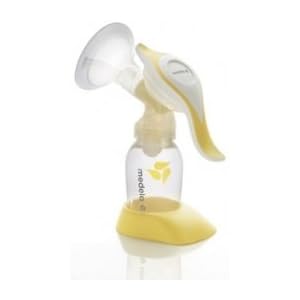
It's important to spend. the. money. I'm sorry, I know it hurts, a good electric pump (again, Hygiea, Ameda, Medela) is going to cost a good solid chunk of change...but believe me when I say it will be worth it. The crappy box store pumps are just that: CRAPPY. It is unusual to find a mom who has success with these. Also, not all manual pumps are created equally. The Medela Harmony is probably the best bet for a manual pump. it's easy to use, simple, effective, and well designed. Not to mention, it allows you to get the correct flange size for you!
Milk collection and your health can be at risk if you don't properly care for your pump. This means inspecting and cleaning it regularly. When you are away from your baby AT LEAST rinse the pieces thoroughly so there is no milk build up in the nooks and crannies, and be sure to TAKE IT APART and wash the pieces every day at the end of your pumping day. When you take it apart inspect the tubing for moisture, mold, and milk. Inspect the membranes and valves for wear...the membranes and valves are soooo important to the function of the pump that even the smallest flaw can impact it's effectiveness...so replace worn bits and pieces regularly. Read your manual, learn the lingo, learn how it works, use it properly, and your pump will last a long time.
I hope something here helps you to pump more effectively. Ask more questions, I just finished an extensive training on breast pumps...I got more to give...you just gotta ask. ;)
7/26/11
Guest Blog: Jessica's Story

My name is Jessica and I have the most beautiful daughter. The last 8 months have been a roller coaster and I wanted to share it with you and your readers:
When I woke up on November 16, the last thing I thought I would do was have a baby. I was 32 weeks pregnant, and my water broke. All I could do at the hospital was cry. I wasn't ready, the baby wasn't ready, my boobs weren't ready. Well, Elizabeth was ready!
She was born a mere 5 hours later. I got to see her for a few short seconds before she was rushed off to the NICU. She needed oxygen at first, then intubation and a vent along with two doses of surfactant to help her lungs inflate/deflate properly.
I started pumping that evening, and continued for about a week or so until I could start trying to nurse.
She didn't take her first feeding until Saturday, November 20th. I remember the exact date because that was a HUGE day for us. That was the first time we got to hold her. We couldn't even touch her before then. A few days later, we were given the go ahead to try to nurse.
At first, Lizzie would open wide, take the while nipple into her mouth, I would get my hopes up....and then she would quickly fall asleep. So, the nurses started letting her latch while gavaging her feeding. That way she would start to realize that mamma's nipple meant full tummy. At that point she was battling jaundice. She was under lights for a total of 10 days. During those 10 days, I could only take her out to attempt to nurse once a day, and she could only be out of the isolette for 45 minutes, maximum. This meant that usually, we would spend most of the 45 minutes struggling her sleepiness to get her to nurse, and my poor husband would only get to snuggle her for 10 minutes or so after I finally gave up and let them gavage a few milliliters.

Slowly, but surely, Lizzie started to get the hang of it. As she grew stronger and more stable, she got moved around to different spots in the NICU. I found out later that a couple of the nurses advocated for us to have the best spots in the corner because she was a good nurser and deserved the good spot - with more privacy.
We spent 29 days in that NICU, and by the end of it, Elizabeth was breastfeeding full feeds at least three times a day, and taking the others from a bottle. Thanks to my diligent pumping right from the beginning, she has only ever had breast milk.
We came home on December 15th, and the transition to full time breastfeeding was hard - on both of us. She had to work harder more often, and I had to spend virtually 24 hours a day with a 5lb baby attached to my breast.
Just when we were getting into a groove and both my husband and I were getting more than 2 hours of sleep at a time, BAM! I needed my gallbladder out - the day before Christmas Eve.
I was told that I needed to pump and dump for at least 24 hours after my surgery, and 24 hours after my last pain pill. I had a nice freezer stash, but not that nice. I only took the prescribed pain pills for one day so I could go back to nursing as soon as possible. I was more determined than ever to not give my daughter any formula. Hey, we made it through a whole month of being separated, I wasn't about to let one little bitty surgery get in my way now! Thankfully, an amazing friend offered to donate some of her frozen milk to bridge any shortage I may have had.
Once I recovered from surgery, we were back to smooth sailing. The amount of time she needed to complete a whole feeding had gone down to about 20 minutes or so, I was actually getting a little sleep, things were great!
Then I went back to work part time.
I was (and am) able to pump once (sometimes twice) during my work day, which is about 7 hours long, including drive time. I did everything to keep my supply up and keep enough milk in the fridge for her. I even pumped while driving. Slowly my supply started to dwindle and my pumping output went way down. *Enter amazing, beautiful, milk donating friend* She not only donated MORE milk to help us out, but gave me tips and encouragement to help get my supply back up. I have to admit, during that time, the sample cans of formula were looking kinda nice.
After trying fenugreek, oatmeal, sports drinks, and tons of water, my supply finally came back.

Now, Elizabeth is eight (8!!!) months old and nursing like a champ. We actually just had a day when she was ALL about the boob and wanted nothing to do with my husband or anyone else. He jokingly said, "Remember when it was a struggle to get her to eat? Geez, where'd that kid go?" Hmph.
She is starting to become more and more mobile, and more and more busy, so lately nursing has been the only break time we get. I love sitting down to feed my amazing daughter and looking into her eyes. We have such a special bond.
I am so very proud of her for being so strong so early. She has shown me a strength I have in myself that I never knew was there. I couldn't have done any of this without the help of my cheerleaders, including my amazing, supportive husband.
It was all so worth it.
7/21/11
Guest Blog: Mandy's Story
10/22/10
Becoming a breast milk donor
![]() |
| This is not a picture of my milk. |
Now, I'm not saying that milk banks aren't a great idea or shouldn't exist. With my current baby, Ella, who as many of you know was born at 29 weeks, if I hadn't produced enough milk or if my preeclampsia had caused me any problems with my milk, insurance would have covered the cost of milk from a milk bank. Is it absolute choice? No, because they do pasteurize it which does affect the nutritional value of breast milk but it is definitely better then formula! In our file somewhere, there is a signed form authorizing the hospital to give Ella donated breast milk if it was necessary.
Fortunately, for me, it wasn't necessary. I pump 40+ oz a day and have milk stored both in my freezer and Meg's freezer. I'm a milk machine. I have more milk then Ella would ever go through unless I decided to stop breastfeeding and as we all know, that is not going to be happening. In fact, since this is my last nursling, I intend on breastfeeding her until she's in college because I wasn't prepared for only two nurslings so I'll be producing breast milk forever. ha ha
Once I filled up my freezer and literally couldn't fit a single more bottle in, I turned to my friend Meg to let me store milk at her house. The day after I did that, I started seriously considering donating milk. I was pumping 40+ ounces a day and my baby was eating 1 ml every hour. It was adding up. Even by the time she got to full feedings for her gestational age, she would be no where near eating what I was producing. Even though I was only 2 weeks in to pumping exclusively, and I knew there was a chance that my supply would decrease, I decided to look into private donation. I did this because I wanted to ensure that a baby who wouldn't get it otherwise, but needed it, would get breast milk. A friend of mine told me about Milk Share, which is an is a parent-to-parent connection tool for those seeking milk and donating milk (http://milkshare.birthingforlife.com/). I went on there and immediately found a posting from an adoptive mom of a preemie baby girl who wanted to provide milk for her baby. I was ecstatic! I contacted her immediately and we set it up. Within a week, she had somewhere around 100 oz of my perfect-for-a-preemie breast milk. I am so thrilled to be able to provide milk for her baby girl! Disclaimer: If you do private milk donation (whether giving or receiving) it's important to ensure that the mother is screened for diseases and dangerous medications.
If you're interested in milk donation, whether private or through a milk bank, here are a few resources:
http://milkshare.birthingforlife.com/
http://www.hmbana.org/ Human Milk Banking Association of North America
http://www.milkbanking.net/ Specifically for low birth weight and premature babies.
Do you know of any other resources? Do you or anyone you know have any experience with milk banks or private donations? Had you ever heard of donating breast milk? What are your thoughts on this?


